
Quick answer: A 3-cup moka pot is the best size for one person who wants a full mug after adding hot water or milk. Choose a 6-cup pot for two people. Moka “cups” are small espresso-style servings, not 8-fluid-ounce US cups.
Shop moka pots by size
Best for one person: see 3-cup Bialetti moka pots on Amazon.
Best for two people: see 6-cup Bialetti moka pots on Amazon.
For induction stoves: see Bialetti Venus stainless-steel moka pots on Amazon.
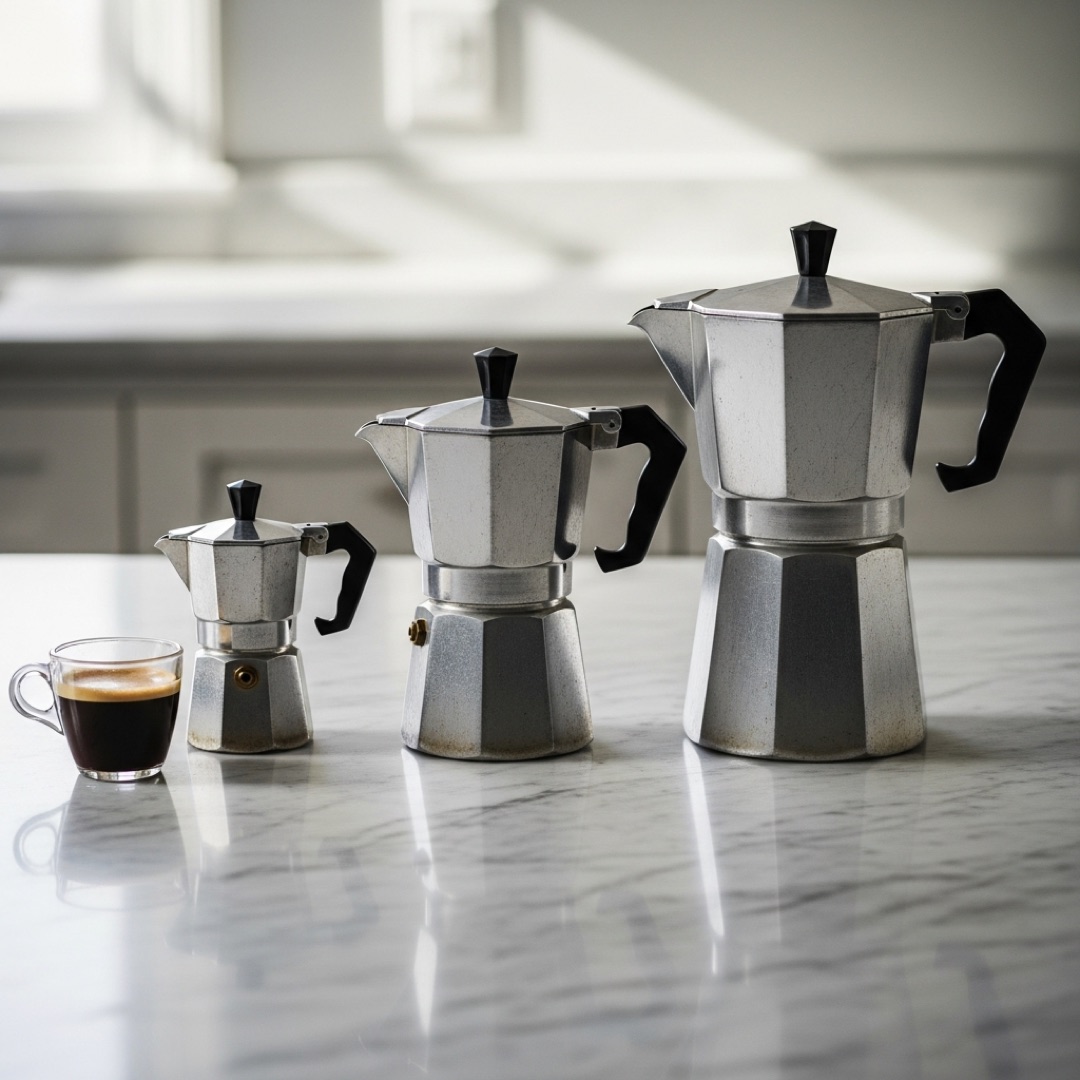
Moka Pot Size Chart
The table below uses Bialetti’s current approximate brewed volumes for the Moka Express. Other brands and models can differ, so check the product specification before buying.
| Labeled size | Approx. brewed coffee | US fluid ounces | Best practical use |
|---|---|---|---|
| 1 cup | 60 ml | 2.0 fl oz | One small, strong serving |
| 2 cup | 90 ml | 3.0 fl oz | One short serving |
| 3 cup | 130 ml | 4.4 fl oz | One person; the most versatile solo size |
| 4 cup | 185 ml | 6.3 fl oz | One large or two small servings |
| 6 cup | 250 ml | 8.5 fl oz | Two people |
| 9 cup | 410 ml | 13.9 fl oz | Two to three people |
| 12 cup | 595 ml | 20.1 fl oz | Three to five people |
| 18 cup | 800 ml | 27.1 fl oz | A group or entertaining |
These are approximate finished volumes, not the amount of water poured into the base. Retained water, grind, dose and heat can change the final yield. The source is Bialetti’s current Moka Express specification and use guide.
What Does “3 Cup” Mean on a Moka Pot?
A moka-pot cup is an espresso-style serving, not a measuring cup and not a standard coffee-shop mug. This is why a 3-cup Moka Express produces roughly 130 ml (4.4 fl oz), not three 8-ounce mugs.
The labeled number is also not a perfectly consistent conversion across every size or model. Treat the manufacturer’s brewed-volume specification as the useful number. A Brikka, Venus or another brand may produce a different amount from a same-numbered Moka Express.
What Size Moka Pot Should You Get?
| Your routine | Recommended size | Why |
|---|---|---|
| One person, very short coffee | 1 or 2 cup | Produces a compact, concentrated serving |
| One person, regular daily drink | 3 cup | Enough to drink short or dilute into a larger mug |
| One person who drinks a lot | 4 or 6 cup | More output, but also more coffee and caffeine |
| Two people | 6 cup | Splits into two 125 ml servings before dilution |
| Three people | 9 cup | About 410 ml total output |
| Four or more people | 12 or 18 cup | Better group capacity without repeat batches |
Best moka pot size for one person
For most solo drinkers, buy the 3-cup size. Its roughly 130 ml yield is substantial enough to drink straight, divide into two small servings, or turn into an Americano-style mug by adding hot water. It is far more flexible than the 1-cup model without requiring the coffee dose of a 6-cup pot.
Choose the 1-cup only if you genuinely want about 60 ml of strong coffee. Choose the 6-cup for one person only if you already know you enjoy roughly 250 ml of concentrated moka coffee or routinely split it across drinks.
1-cup vs 3-cup moka pot
The 1-cup is compact but produces only about 2 fl oz. The 3-cup yields about 4.4 fl oz and is the safer purchase for most people. It gives you enough coffee for a fuller drink while still heating relatively quickly. The smaller model makes sense for minimalists and people who want one short, intense serving.
3-cup vs 6-cup moka pot
Choose the 3-cup for one regular drinker and the 6-cup for two people. The 6-cup’s approximate 250 ml yield is almost double the 3-cup’s 130 ml. It also requires a larger basket of coffee, takes longer to heat and produces more caffeine overall.
Can You Make One Cup in a 3-Cup Moka Pot?
You can drink the entire output as one serving, but you should not normally half-fill a 3-cup pot to imitate a 1-cup model. A moka pot is designed around its boiler, funnel and basket proportions. Bialetti instructs users to fill water to just below the safety valve and loosely fill the funnel with coffee.
Do not tamp the grounds. If 130 ml is more concentrated coffee than you want, brew the designed batch and add hot water or milk. If you consistently need less, buy the smaller pot.
Why Buying Too Large Usually Backfires
- You cannot scale the basket like a drip machine. Using a token amount of grounds in an oversized basket changes how water travels through the coffee.
- Larger pots consume more coffee. A 6-cup pot is not simply a 3-cup pot with optional extra capacity.
- They take longer to heat. More water and metal mean a slower morning brew.
- The caffeine adds up. Moka coffee is concentrated, and drinking a group-size batch alone can be excessive.
Choose for your normal weekday routine, not the occasional guest. A second larger pot is more sensible than making an oversized model your daily brewer.
Moka Pot Coffee Is Strong, but It Is Not Espresso
Moka pots use steam pressure to push hot water through coffee, but they do not reach the pressure of a pump espresso machine. The drink is concentrated and works well with milk or hot water, yet it is technically different from espresso. Our guide to whether moka pots make espresso explains the distinction.
Size Is Not the Only Buying Decision
Aluminum or stainless steel
The classic Moka Express uses aluminum. Stainless-steel models are generally more durable and some work on induction, but construction varies. Compare the tradeoffs in our aluminum vs stainless-steel moka pot guide.
Check induction compatibility
A standard aluminum Moka Express is not directly induction compatible. Bialetti sells induction-compatible models with a suitable base, and converter plates are another option. Before ordering, verify both the model and the smallest pan diameter your hob detects. See our guide to moka pots on induction.
Use the correct grind
Use a medium-fine grind: finer than typical drip coffee but coarser than powdery espresso grind. Fill the basket loosely and level it without tamping. Read our moka-pot grind-size guide for a more precise comparison.
How to Brew Without Burning the Coffee
- Fill the boiler with water to just below the safety valve.
- Insert the funnel and loosely fill it with medium-fine coffee.
- Level the grounds; do not tamp.
- Screw the chambers together firmly without using the handle for leverage.
- Heat on low to medium, keeping a gas flame beneath the base.
- Remove the pot from heat when the upper chamber is nearly full and before prolonged sputtering.
- Stir the collected coffee before pouring so the stronger early brew mixes with the later liquid.
For a complete walkthrough, see how to use an Italian moka pot. For beans and roast choices, compare the best coffee for a moka pot.
Frequently Asked Questions
What is the standard moka pot size?
There is no single standard, but 3-cup and 6-cup models are the most practical starting points. The 3-cup suits one person; the 6-cup suits two.
How many ounces does a 3-cup moka pot make?
Bialetti lists approximately 130 ml, or 4.4 US fluid ounces, for the 3-cup Moka Express. Actual yield varies with water level, coffee and grind.
How many ounces does a 6-cup moka pot make?
The current Bialetti Moka Express specification lists about 250 ml, or 8.5 US fluid ounces, for the 6-cup model.
Can a 6-cup moka pot make less coffee?
It is better to use a pot sized for the batch you want. Moka pots are designed to brew with water below the valve and a properly filled funnel. Routinely underfilling a 6-cup model is less predictable than using a 3-cup pot.
Which moka pot size is best for two people?
A 6-cup model is the best general choice for two people. Its approximate 250 ml output divides into two 125 ml portions, which can be served strong or diluted with water or milk.
Bottom Line
Buy the smallest moka pot that comfortably covers your normal batch. For most shoppers, that means 3 cups for one person and 6 cups for two people. Use the milliliter capacity—not the word “cup”—to compare models accurately.
If you are still comparing models, see our roundup of the best moka pots and our guide to electric moka pots.