
For a standard French press, use 1 gram of coffee per 15 grams of water as your starting ratio.
The French press coffee ratio question has gotten muddled with all the conflicting measurements and brewing guides flying around. As someone who has brewed French press almost exclusively for years and gone through countless bags of beans dialing in different ratios, I learned what actually produces a consistently good cup. Today, I’ll cut through the noise and give you what works.
[lasso type=”table” id=”6″ link_id=”129690″]
The French Press (Bodum) Method
The French press is genuinely one of the simplest ways to make coffee, which is part of why it produces such reliable results when you get the basics right. The setup is minimal: a cylindrical pot, a plunger, and a mesh screen. No paper filters, no electrical components, nothing to break except the glass.
The brewing process works by steeping coffee grounds directly in hot water, then pressing the plunger to separate the grounds from the liquid through the mesh screen. Because there’s no paper filter to strip oils, French press coffee has a naturally rich, full-bodied flavor and a slightly heavier texture than drip coffee. That oil and texture carry the flavor in a way that paper filtration removes.
How Do You Make French Press Coffee?
If you want to make good coffee with a French press, the steps are straightforward once you understand why each one matters.
Step 1. Prepare the Water and Beans
Bring water to a boil, then take it off the heat and let it rest for 30-45 seconds. You’re targeting around 200°F. Boiling water (212°F) scalds lighter roasts and produces a flat, harsh flavor. The brief rest brings you into the right temperature range without any measuring equipment needed.
While the water heats, grind your beans with a burr grinder. French press needs a coarse grind — roughly the texture of coarse sea salt. A blade grinder produces inconsistent particle sizes that cause uneven extraction and muddy sediment in the cup.
Step 2. Fill the French Press
Add your ground coffee to the French press first, then pour the water over it slowly and evenly. This “blooms” the coffee — releases trapped carbon dioxide that would otherwise interfere with extraction — and ensures all the grounds are saturated equally.
Step 3. Stir and Brew
Give the grounds a solid stir after pouring to ensure even saturation, then put the lid on (plunger up) and let it brew for four minutes. I’ve found that four minutes is the sweet spot — enough time to extract full flavor without crossing into bitter territory. You can experiment with three minutes for lighter cups or five for stronger, but four is where most people land and stay.
Step 4. Plunge and Serve
Press the plunger down slowly and steadily. If it offers heavy resistance, your grind is too fine. If it drops with almost no resistance, too coarse. Moderate, even pressure is what you’re after. Pour immediately — don’t let the coffee sit in the press after plunging, as the grounds continue extracting and the coffee turns bitter.
How Much Coffee For French Press?
The ratio depends on your measurement system and how strong you want the cup.
In standard measurements: 2 tablespoons of ground coffee per 6 ounces of water is a common starting point. For a bolder cup, push to 2.5 tablespoons per 6 ounces. In the metric system: 50-65 grams of coffee per liter of water, depending on desired strength.
For a precise ratio breakdown, the 1:15 ratio (1 gram coffee to 15 grams water) is the standard starting point most specialty coffee guides recommend. In my experience, 1:14 produces a notably richer, more satisfying cup without crossing into harsh or bitter — but preferences vary and it’s worth dialing in your own ratio over a few brews.
Water quality matters too. Coffee is mostly water, so the quality of your water directly affects the final cup. Clean tap water works fine in most areas. If your tap water has a strong taste, filtered or spring water makes a noticeable difference.
What Should the Grind Size Be for the French Press?
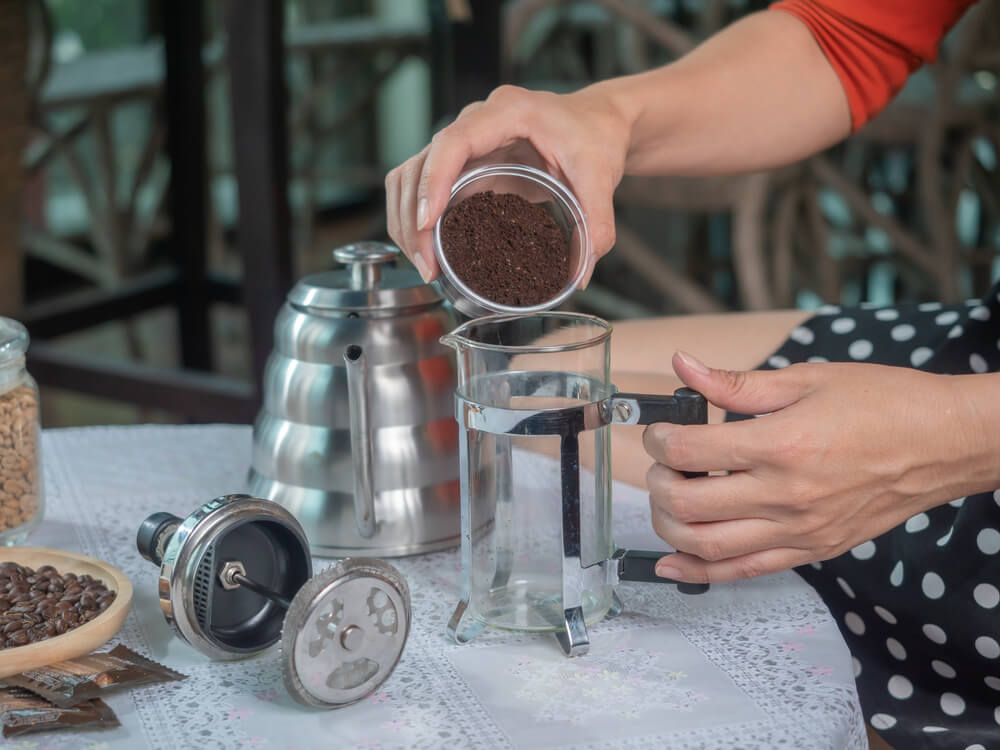
For French press, target a grind size between 0.75mm and 1mm — this is what’s described as “coarse” on most burr grinders. Grind fresh, right before brewing. Pre-ground coffee is fine in a pinch but loses volatile aromatics quickly and you’ll notice the difference within a few days of the bag being opened.
The consequence of the wrong grind size: too fine produces over-extraction and harsh bitterness, with fine particles slipping through the mesh screen into your cup. Too coarse produces under-extraction — thin, watery coffee that tastes flat and sour. Getting the grind right solves most French press problems before they start.
Use a burr grinder rather than a blade grinder. The consistent particle size from a burr grinder is what makes repeatably good French press coffee possible. With a blade grinder, each batch is a different particle size distribution, and the results vary accordingly.
The Final Word on How Much Coffee For A French Press
Start with 2 tablespoons of coarse-ground coffee per 8 ounces of water, or 1:15 by weight. Brew for four minutes at around 200°F. Plunge slowly and pour immediately. Adjust the ratio over subsequent brews — more coffee for stronger, less for lighter — until you find what works for your beans and your palate.
The other things that matter: use a burr grinder, use good water, and don’t let the brewed coffee sit in the press. Those three things combined with the right ratio produce French press coffee that’s genuinely difficult to improve on.
FAQs About How Much Coffee for a French Press
Why does my coffee taste so bitter?
When you make French press coffee, you need to drink it immediately. There are always a few coffee grounds at the bottom of your cup. If you let them sit in your coffee, they will continue to release oils, making your coffee taste bitter.
Why does my coffee taste so thin?
If your coffee is a bit weak, you may want to allow your coffee to brew for a bit longer. Or, your grind size may be too coarse. Make your grind a little finer and see if this helps.
Our Testing Notes
We’ve tested this brewing method extensively in our coffee lab, and here’s what the data doesn’t always tell you:
Water temperature matters more than most guides suggest. We found that 200-205°F consistently produced better extraction than the often-recommended 195°F. The difference was especially noticeable with lighter roasts—underheat them and you get sour, underwhelming coffee that wastes good beans.
The grind size recommendations online are a starting point, not gospel. Your specific grinder, beans, and even altitude affect optimal grind. We keep a brewing journal and adjust by one click finer or coarser until dialing in a new bag. Takes about 3 brews to nail it.