
AeroPress and pour over both make excellent manual coffee, but they suit different preferences and situations.
AeroPress is faster, more portable, and forgiving of technique. Pour over offers more control and produces a cleaner cup. Your priorities determine the better choice.
What Do The AeroPress And Pour Over Have In Common?
Both the AeroPress and the pour-over are manual coffee makers, which means that you have the freedom to experiment with variables such as coffee vs. water ratio and brewing time. Here are a few more things that AeroPresses and pour overs have in common:
- The AeroPress is compact and portable and so are many pour overs, such as the Hario V60 and the Kalita Wave. However, if you want a good cup of coffee from your pour over, you may also want to take your gooseneck kettle and scale. Both devices require filters.
- Cleaning both devices is quite simple. The most finicky device to wash is probably the Chemex, due to its hourglass figure. However, you can pop the whole brewer in a dishwasher.
- Both devices cost roughly the same price and are quite affordable. However, the Chemex is a bit pricier due to its unique and beautiful design.
What’s The Difference Between Immersion And Pour-Over Brewing Methods?

With the AeroPress, coffee is brewed through the immersion method, while pour-overs involve the pour-over method. When coffee is made through the immersion method, coffee grounds are immersed in hot water and left for a while until the coffee is appropriately extracted. In general, this method provides a bolder cup of coffee with a heavier mouthfeel.
The pour-over, or drip, method, on the other hand, involves slowly pouring hot water over coffee grounds and then allowing gravity to draw the water through the coffee bed. With drip brewing, you receive a more complex-flavored cup of coffee because the water extracts the coffee oils and solubles in its own time.
Check out our reasons why you should use a pour-over coffee maker.
Comparison Between An AeroPress Vs. Pour Over
|
AeroPress |
Pour Over |
|
With the AeroPress, you receive a full-bodied coffee brew with a fair amount of mouthfeel and weight in the cup. | Although an AeroPress does require human input, it involves a less precise technique than a pour-over. |
| The amount of coffee you can brew in one go depends on the type of pour-over. The Hario V60, for instance, can provide one to three cups, while the Chemex can provide up to 13 cups of coffee. |
Pour-over coffee requires technique. To brew the perfect cup of coffee, you need to get the various brewing variables, such as coffee vs. water ratio and water temperature, right. This method also requires a specific pouring technique. |
|
You can brew coffee within one to two minutes, depending on the amount of coffee you’re brewing. |
The brewing time should typically take anything from three to four minutes. However, your grind size, for instance, may influence this. Water will take longer to run through a fine grind than a coarser grind. |
|
With one pressing, you can brew up to three servings. | A serving with the AeroPress is smaller than you’ll get from a pour-over. However, you can dilute the brew with milk or water to provide you with a full cup. |
| A pour-over delivers a full cup of coffee or multiple cups. | The grind you choose will depend on the pour-over. Typically, grind size ranges from medium-fine to medium-coarse. |
|
Since the water comes into contact with the coffee grounds for a shorter period, you want to use a medium-fine grind with the AeroPress. |
The grind you choose will depend on the pour over. Typically, grind size ranges from medium-fine to medium-coarse. |
What’s Better About An AeroPress?
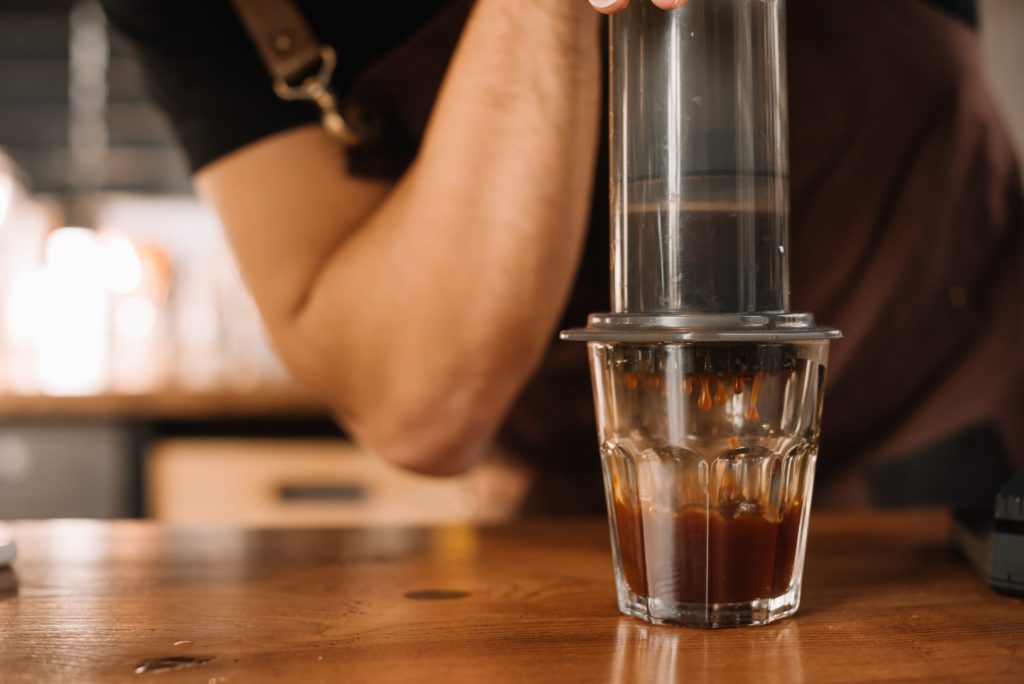
The coffee you get from an AeroPress will be of more consistent quality than you get from a pour-over. This coffee maker delivers a bold espresso-style brew, and you don’t have to go through too much trouble to make it. Although making coffee with an Aero press requires a bit of input, the method is not as involved as with a pour-over.
What’s Better About A Pour Over?

Pour overs such as the Chemex provide a stunningly clear and nuanced cup of coffee. With the Chemex, the clear coffee is due to extra thick filters that filter most of the coffee oils and sediment. Pour overs such as the Chemex are also beautifully designed and more attractive to look at than the AeroPress.
Who Should Go for An AeroPress?
If you like your coffee strong and espresso-like, the AeroPress is a good option. This coffee maker is also the best choice for those who don’t want to fuss too much when it comes to variables such as the precise weight of the grinds or pouring techniques.
This coffee maker is also well-suited to those who don’t need to brew big batches of coffee. And, as it’s portable and made from plastic, it’s ideal for camping and travel.
Who Should Go for A Pour Over?
Coffee drinkers who prefer a milder and clear cup of coffee with nuanced and complex flavors should opt for a pour over. A pour over is also the better option if you want to brew bigger batches of coffee.
Pour overs such as the Chemex, for instance, can brew up to 13 cups of coffee at a time. Pour overs are well-suited to those who like to experiment with different brewing variables and fine-tune their technique to produce the perfect cup of coffee.
Shop on Amazon
Looking to buy? Check out our top picks on Amazon:
This article contains affiliate links. As an Amazon Associate, we earn from qualifying purchases at no additional cost to you.
Our Testing Notes
We’ve tested this brewing method extensively in our coffee lab, and here’s what the data doesn’t always tell you:
Water temperature matters more than most guides suggest. We found that 200-205°F consistently produced better extraction than the often-recommended 195°F. The difference was especially noticeable with lighter roasts—underheat them and you get sour, underwhelming coffee that wastes good beans.
The grind size recommendations online are a starting point, not gospel. Your specific grinder, beans, and even altitude affect optimal grind. We keep a brewing journal and adjust by one click finer or coarser until dialing in a new bag. Takes about 3 brews to nail it.